Building and Pest Inspection Cost in Australia (2026 Guide)
Discover the cost of building and pest inspections in Australia for 2026. Learn about typical price ranges, factors influence costs, and how to select the best inspection service.
A thorough inspection gives clear information and reduces uncertainty.
Rather than just looking at what’s visible, buyers get a better idea of the property‘s real condition.
- Helps find hidden structural damage
- Identifies termite and pest risks early
- Supports better financial choices
For first–time buyers in particular, this step can help avoid costly surprises after buying a home.
1: What a Building and Pest Inspection Covers
A building and pest inspection in Australia combines two important checks into one.
The building inspection looks at the structure of the house, making sure it is safe and solid. The pest inspection checks for threats like termites or other pests that might damage the property.
Inspectors look at the visible parts of the home, such as the roof, walls, floors, and drainage system.
For pest inspections, they pay special attention to areas where pests are likely to hide, like under the floorboards or in timber structures.
The main things checked include the condition of walls, roof, and foundations, signs of water damage or dampness and any evidence of termite activity or where pests could enter the property.
The overall goal is to give a full and fair picture of the property‘s condition.
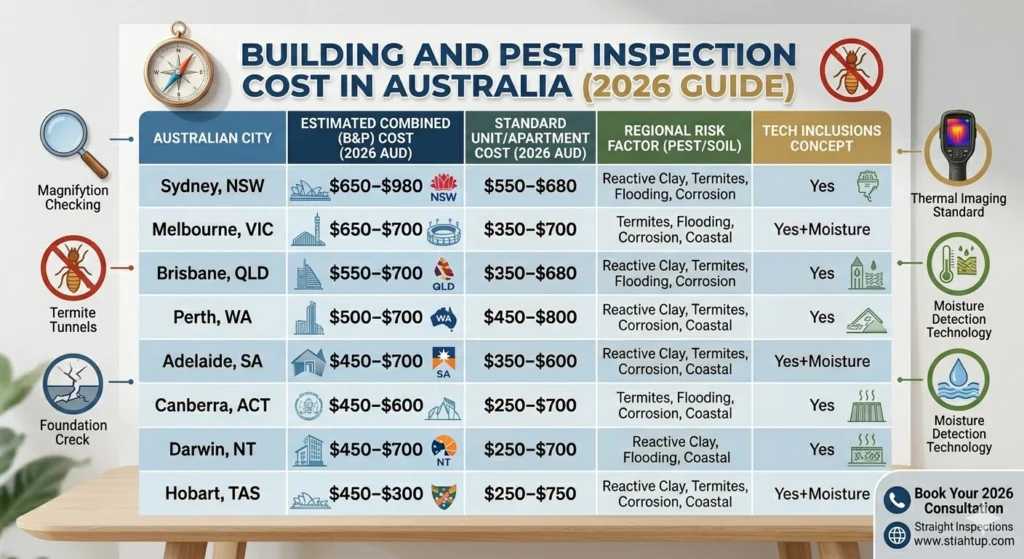
2: Average Building and Pest Inspection Cost in Australia (2026)
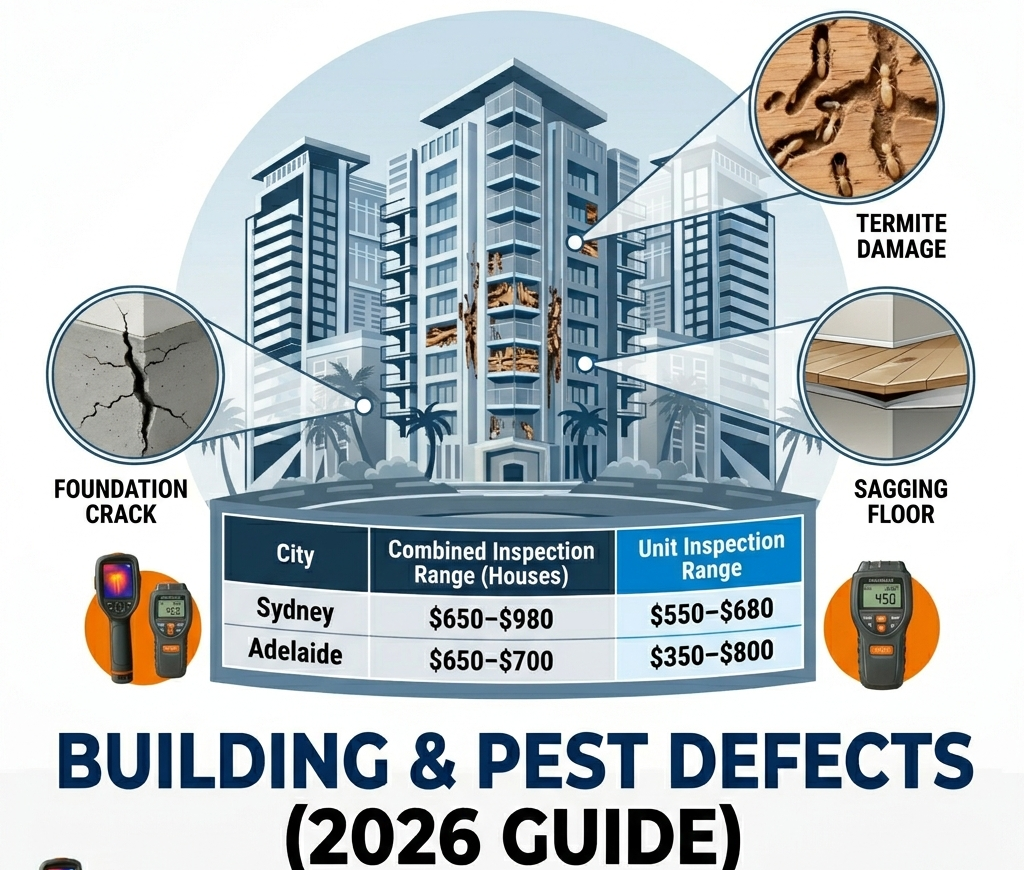
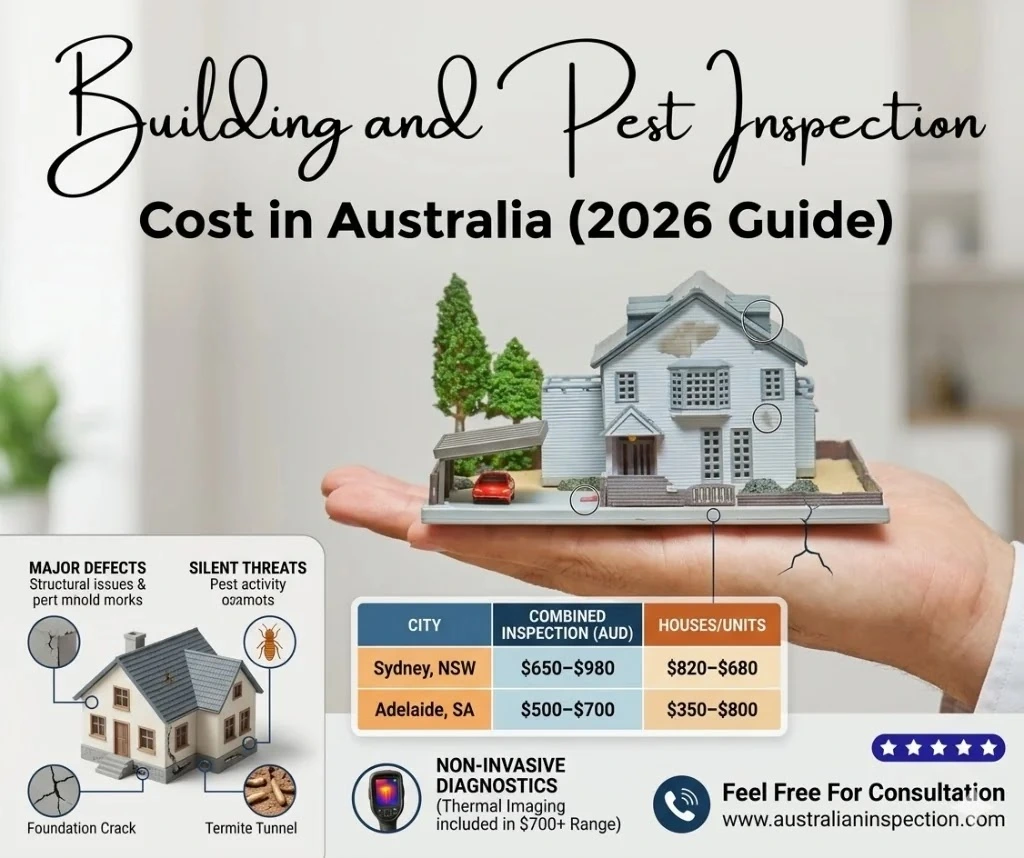
The cost of a building and pest inspection in Australia depends on the type, size, and location of the property.
In 2026, most combined inspections are priced reasonably.
For regular homes, the cost is usually between $400 and $900.
Smaller apartments are generally cheaper, while bigger houses or more complex buildings cost more.
Apartments tend to have lower costs because they are smaller.
Standard houses fall in the middle in terms of price. Large or multi-storey homes usually cost more to inspect.
This cost is small compared to the total value of the property and the savings you might get from knowing its condition beforehand.
3: Cost Differences Across Australian Cities
The price of an inspection can vary in different Australian cities based on demand, property values, and how easy it is to get services.
In big cities like Sydney and Melbourne, prices are typically higher because of more demand and higher property values.
Cities like Brisbane, Perth, and Adelaide might be a bit cheaper.
In major cities, combined inspections usually cost between $500 and $900.
In some regional areas, they might be closer to $400 to $700, depending on how easy it is to reach the property.
It’s important to understand the local market when booking an inspection.
4: Factors That Influence Inspection Costs
Several things can affect how much you pay for a building and pest inspection.
These factors explain why prices can vary from one property to another.
Size and Layout of the Property
Larger homes take more time to inspect.
If the house has multiple floors, a complicated layout, or extra structures like a garage or extension, the inspection will take longer.
Age of the Property
Older properties may have more wear and tear.
Inspectors need to spend more time looking for hidden issues, which can increase the cost.
Accessibility
If certain parts of the house are hard to reach, like tight roof spaces or subfloor areas, the inspection may take longer, which can slightly raise the cost.
Technology Used for Inspection
Some inspectors use advanced tools like thermal imaging to find moisture or hidden problems.
This can improve the accuracy of the inspection but might also affect the cost.
5: Building Inspection vs Pest Inspection
A building inspection and a pest inspection are both important, but they serve different purposes.
- Building inspection checks the structural aspects of: The property, looking for issues like cracks, foundation movement, or water damage.
- A pest inspection focuses on finding termites or other pests and the conditions that might attract them.
- Choosing a combined service means getting both assessments done at the same time, saving time and effort.
Building inspection: Checks for structural damage and safety
Pest inspection: Looks for termite activity and pest risks
This combined approach gives a more complete picture of the property.
6: Why Inspection Costs Are a Practical Investment
Some buyers might see inspection costs as an extra expense, but in reality, they act as a preventive investment.
Spending a reasonable amount on an inspection can help avoid much higher repair costs later.
Undetected structural issues or pest damage can result in expensive renovations.
- Prevents unexpected repair expenses
- Provides negotiation leverage during purchase
- Enhances confidence in decision–making
From a long–term perspective, inspections contribute to financial security.
7: Real–Life Scenario: Cost vs Risk
Consider a situation where a buyer skips a pest inspection to cut down on upfront costs.
Initially, the property appears to be in good condition, and no visible problems are noticed.
However, after the purchase, termite damage becomes apparent in the timber structures.
Fixing this issue involves pest treatment and structural repairs, leading to significant costs.
In contrast, a pre–purchase inspection—usually costing around $500 to $800—could have identified the issue early.
This would allow the buyer to renegotiate or reconsider the purchase.
This example demonstrates how inspection costs help minimize long–term risks.
8: Choosing a Reliable Inspection Service in Australia
Selecting the right inspection provider is essential for accurate results.
Not all services offer the same level of expertise or reporting quality.
Buyers should prioritize licensed and insured inspectors with experience in local property conditions
for building and pest inspections. Reviewing sample reports can also give insight into the level of detail provided.
When comparing quotes, it is essential to ensure the firm meets national standards.
Professional Indemnity: Never hire an inspector who is not fully insured.
This insurance protects you if a major defect is missed.
Licensed Experts: Requirements vary by state, but a licensed builder or surveyor provides a much higher level of authority.
Report Quality: A professional report should be 40-60 pages long, including high–resolution photos and clear “Action“ items.
A reliable inspection service provides clear, easy-to-understand findings that support informed decisions.
9: How Location in Australia Affects Inspection Cost and Risk
Location plays a significant role in both building and pest inspection costs in Australia and the type of issues inspectors commonly find.
Properties in coastal areas often face moisture–related problems, while inland regions may experience soil movement that affects foundations.
High–demand cities also tend to have slightly higher inspection prices due to market activity.
Coastal areas: Higher moisture and corrosion risks
Urban cities: Higher service demand
Regional areas: Possible travel–related cost variations
Understanding location–specific risks helps buyers interpret inspection reports more effectively.
10: When a Combined Inspection Is More Practical Than Separate Services
Many buyers consider booking building and pest inspections separately, but in most cases, a combined service is more practical.
A combined inspection ensures that both structural and pest–related issues are assessed during a single visit.
This reduces time pressure during property transactions and avoids coordination issues between multiple inspectors.
Single appointment saves time
More consistent reporting
Better overall property assessment
From a decision–making perspective, a combined inspection provides a clearer and more complete picture.
11: Warning Signs That Make an Inspection Essential
While inspections are recommended for all properties, certain warning signs make them absolutely necessary.
Visible cracks, uneven flooring, or signs of moisture should not be ignored.
Even minor indicators can point to larger underlying problems.
Cracks in walls or ceilings
Damp smells or visible mould
Sagging roofs or uneven structures
These signs suggest potential risks that require professional evaluation before proceeding with a purchase.
12: How Inspection Quality Impacts Property Decisions
Not all inspection services are created equal.
The level of detail in the analysis and how clearly the report is written can have a big impact on the decisions buyers make.
A thorough inspection report gives buyers a clear picture of what problems exist and how serious they are.
On the other hand, poor–quality reports can confuse buyers or miss key details.
Clear explanations help buyers understand the situation better.
Visual evidence supports the findings. Accurate assessments reduce uncertainty.
Choosing a high quality inspection service ensures that decisions are based on reliable and accurate information.
13: The Financial Impact of Undetected Property Issues
One of the biggest risks when buying a property is missing hidden defects.
These issues often go unnoticed without a professional inspection.
Structural damage or termite infestations can lead to repair costs that are much higher than the initial inspection fee.
In some cases, these repairs can also affect the property‘s overall value.
Structural repairs can be very expensive.
Pest damage may spread if not treated. Delayed fixes can increase the total cost.
This highlights why inspection costs should be viewed as a protective measure rather than an optional expense.
14: How Inspections Improve Buyer Confidence in Competitive Markets
Australia’s property market can be very competitive, especially in major cities.
In such conditions, buyers may feel pressured to make fast decisions.
A professional inspection helps reduce uncertainty, allowing buyers to proceed with more confidence.
Even in fast–moving markets, having verified information provides a strong advantage.
Reduces risk in quick decisions
Provides clarity during negotiations
Supports confident property selection
In competitive environments, informed decisions are more valuable than rushed ones.
15: Navigating Competitive Markets with Confidence
Australia’s property market can be highly competitive, especially in major cities like Sydney and Melbourne.
In such high pressure situations, buyers often feel the need to make quick decisions to avoid missing out on a good property. However, rushing into a major purchase without proper checks can be a big risk.
A professional inspection helps reduce this uncertainty, giving buyers a crucial “pause“ to make more confident decisions.
Even in fast–moving markets or “best and final offer“ scenarios, having verified information about the property‘s condition provides a strong advantage. This allows buyers to make offers based on facts rather than emotions.
Reduces risk in quick decisions: Knowing the exact condition of the property helps avoid regret after the sale.
Provides clarity during negotiations: You can back up your offer price with technical evidence.
Supports confident property selection: You can quickly filter out properties that may become costly problems and focus on high–quality homes.
In competitive environments, informed decisions are always more valuable than rushed ones.
By understanding the true cost of building and pest inspections in Australia, you give yourself the confidence to navigate the market wisely and protect your finances.
Conclusion:
The cost of building and pest inspections in Australia is a manageable expense that offers significant value.
It provides insight into the property‘s condition, reduces uncertainty, and supports better financial decisions.
In 2026, with increasing awareness of property risks, inspections have become a standard part of the buying process.
While costs may vary, the benefits remain consistent across different property types.
By understanding pricing, choosing a reliable inspector, and acting on inspection reports, buyers can approach property transactions with confidence and clarity.
FAQs
1. How much does a building and pest inspection cost in Australia in 2026?
Costs generally range between $400 and $900, depending on property size, location, and inspection complexity.
Combined inspections are usually more cost–effective than separate services.
2. Is a building and pest inspection necessary for new homes?
Yes, even newly built homes can have defects or incomplete work.
An inspection gives an independent assessment of quality and safety.
3. How long does a building and pest inspection take?
Most inspections take between 1 to 3 hours, depending on the property size and accessibility.
Reports are usually delivered within 24 to 48 hours.
4. What happens if you skip a building and pest inspection?
Skipping an inspection can leave hidden issues like structural damage or termites undetected.
This may result in unexpected repair costs after the purchase. It also removes the ability to negotiate based on the property‘s actual condition.