
18 September 2026 · News
Building Inspection Canberra: The Complete 2026 Buyer’s Guide to Hidden Defects
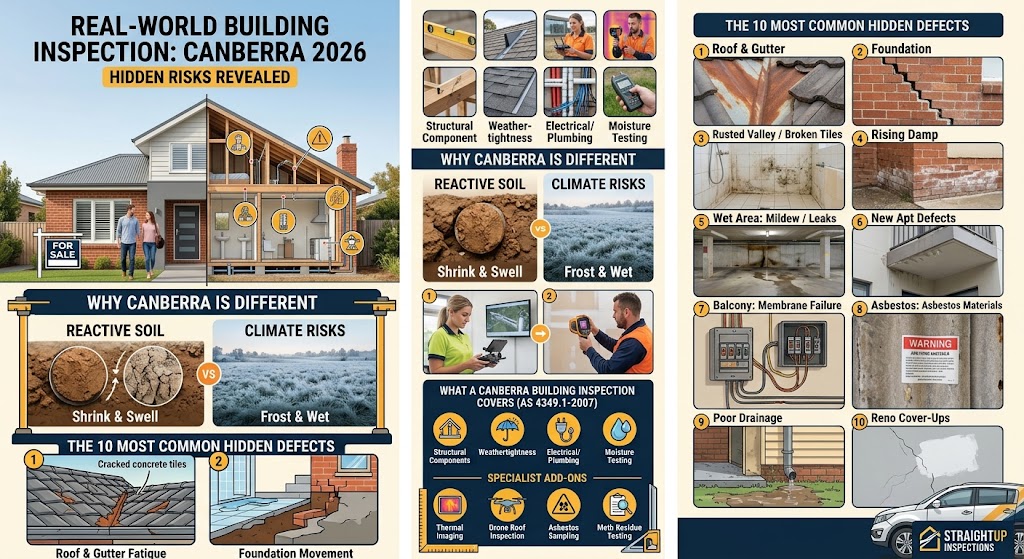
Buying a home in Canberra is one of the most significant financial decisions you will ever make. But a freshly painted room or a sparkling new kitchen can mask problems that will cost you thousands. In a city built on reactive clay soils and subject to frosty winters and wet springs, the risks are real — and often invisible during a standard open home walkthrough. This guide covers everything you need to know about building inspections in Canberra, from the most common defects our inspectors find to what you should expect to pay in 2026.
Why Canberra Homes Are Different (And Why That Matters for Buyers)
Canberra’s building stock is as diverse as its landscape. From the 1920s “Govie” cottages in Kingston to the modern apartment towers on the foreshore, every era brings its own set of risks.
But one factor unites them all: the soil.
Much of the ACT is built on moderately to highly reactive clay, classified under AS2870. This clay shrinks dramatically during Canberra’s dry summers and swells during wet winters. The result is cyclical ground movement that puts constant stress on foundations and footings.
The Bureau of Meteorology historical data records mean minimum temperatures around 0°C in July, with similarly cold conditions through June and August. This freeze-thaw cycle compounds the problem, particularly for older homes built to the standards of their time — narrower edge beams and less reinforcement than modern requirements.
What does this mean for you as a buyer? Foundation movement is not a matter of if, but how much — and the severity depends heavily on site drainage. Homes where downpipes discharge onto the ground beside the slab consistently show more pronounced movement than those with fully connected stormwater.
The 10 Most Common Building Defects in Canberra Homes
Based on thousands of inspections across the ACT, here are the defects our team encounters most frequently.
1. Roof and Gutter Fatigue
Concrete terracotta tile roofs on Canberra’s 1970s and 1980s homes are now 40 to 50 years old and showing consistent signs of fatigue. Ridge bedding and pointing have hardened, cracked, and in many areas lifted away from the tile profile. Valley trays at roof intersections — typically galvanised steel — show corrosion at overlaps and seams.
What to watch for: Replacement tiles that do not match the original profile, creating gaps at the interlock. Gutters that have been partially replaced (typically a front section) while rear runs remain original and at the end of their serviceable life.
2. Foundation Movement and Cracking
This is the single most common structural defect we document. Stepped cracking in brickwork at window and door openings, doors and windows that bind during wet winters and loosen in dry summers, and cornice separation at wall-to-ceiling junctions are all tell-tale signs.
In most cases, these are within the normal range for a 50-year-old home on reactive clay. But the severity depends heavily on drainage. Disconnected downpipes, blocked stormwater, and cracked clay pipes saturate the soil next to the footing, swelling the reactive clay or washing soil away entirely.
3. Failed Wet Area Waterproofing
Original bathroom waterproofing from the 1970s is now well past its effective life. We regularly document tiled shower hob failures where the membrane seal has failed, flexi-hose connections under vanities that have begun to weep, and WC pan outlets where the seal has deteriorated, tracking moisture into adjacent flooring and cabinetry.
4. Rising Damp in Brickwork
Common in Canberra’s older suburbs where garden beds have been built up above the original damp-proof course level over decades of landscaping changes. Rising damp in brickwork at ground level is particularly prevalent in heritage precincts like Kingston’s Garden City.
5. Concrete Defects in New Apartments
A growing concern across the ACT. Multiple remediation businesses report that the majority of their growing workload is on apartment buildings less than 10 years old. Structural engineer Mal Wilson blamed developers cutting costs on design and construction over the past 15 years for the increase in concrete defects.
The most common issues include water penetrating into basements and balconies leaking back into the building or down onto the balcony below. One engineer noted that basement water can be so alkaline it strips paint from cars.
6. Balcony Waterproofing Failures
Particularly in Kingston Foreshore and other modern apartment precincts. We document balcony waterproofing membranes where the junction with the building facade has failed, allowing water to track down to the balcony below or into the wall cavity. Planter boxes on terraces and common-area podium slabs leak where the membrane was not correctly terminated at the drainage layer.
7. Aged Electrical Systems
Overloaded switchboards, exposed wiring in roof voids, and evidence of DIY electrical work are the kinds of findings we note in building reports so buyers can act on them before settlement.
8. Asbestos-Containing Materials
Fibro cement sheeting in eaves, linings, and some internal wet-area walls is common in 1970s Canberra construction. While intact asbestos is generally low-risk, any renovation or repair work will require specialist handling.
9. Poor Site Drainage and Stormwater Issues
This is arguably the most underrated defect we see. Poor drainage doesn’t just cause localised damp — it directly accelerates foundation movement. Homes with disconnected downpipes consistently show more pronounced structural issues than those with fully connected stormwater systems.
10. Renovation Cover-Ups
A freshly renovated home can hide serious defects behind new plasterboard and tiles. Water damage, failed waterproofing, and structural cracking are all too easily painted over. This is why an independent inspection is essential — even for properties that look “ready to move into.”
What Does a Canberra Building Inspection Actually Cover?
A standard pre-purchase building inspection in Canberra is a visual, non-invasive assessment conducted in accordance with Australian Standard AS 4349.1-2007. Our trade-qualified inspectors assess:
- Structural components — foundation, walls, roof framing
- Weathertightness systems — roof, gutters, flashings, external cladding
- Electrical installations — switchboard, visible wiring
- Plumbing infrastructure — visible pipework, drainage
- Moisture testing — wet areas and suspected damp zones
- Safety hazards — asbestos indicators, trip hazards, structural risks
Every report includes moisture testing results, structural analysis, and detailed photo documentation to support confident property negotiations.
What’s NOT Included (And Why That Matters)
It’s important to understand the limitations. A standard inspection does not include breaking apart, dismantling, or removing objects. Roof drainage is not tested. Hazardous materials and contamination are not covered unless specifically requested.
This is why experienced buyers often opt for specialist add-ons such as thermal imaging, drone roof inspections, asbestos sampling, or meth residue testing.
How Much Does a Building Inspection Cost in Canberra? (2026 Pricing)
A pre-purchase building and pest inspection in Canberra costs $450–$900 for a standard house in 2026, $300–$600 for building-only on a unit, and $700–$1,400 for large, heritage, or inner-city homes. Specialist add-ons range from $150 to $600 each.
| Inspection Type | Typical Cost (2026) |
|---|---|
| Pest / timber inspection only | $200–$400 |
| Building-only (unit or small home) | $300–$600 |
| Combined building & pest (standard house) | $450–$900 |
| Combined, large / heritage / inner-city | $700–$1,400 |
| Specialist add-ons (thermal, drone, asbestos) | $150–$600 each |
Pro tip: Booking building and pest together is cheaper than two separate visits. The bundle discount is real, and most Canberra inspectors offer it.
New Home Construction Inspections: Don’t Skip These Stages
If you’re building a new home in Canberra, stage inspections are not optional — they’re your only opportunity to catch defects before they’re covered up.
Building companies in Canberra are required to complete specific stages, and we recommend inspections at five key points:
- Slab Stage (prior to pouring concrete) — Beams and footings checked, edge rebate inspected for honeycombing and steel reinforcement coverage
- Frame Stage — Structural framing, bracing, and tie-downs
- Lockup Stage — Roof, windows, external doors before internal linings
- Pre-Lining — Electrical, plumbing, and insulation before plasterboard
- Practical Completion / Handover — Final defects inspection before keys
For larger homes, additional inspections are recommended.
The Seller’s Report Question: Do You Need Your Own Inspection?
Under ACT law, sellers are required to provide a building and compliance report, timber pest report, and energy efficiency rating statement as part of the sale process. But a seller’s report is not the same as your own independent inspection.
A seller’s report is prepared for the seller’s benefit. It may not cover the specific areas you’re concerned about, and it may not be as thorough as an inspection you commission yourself. For a relatively small cost, your own inspection gives you independent, unbiased information about the true condition of the property.
How to Choose a Building Inspector in Canberra
Not all inspectors are equal. When selecting an inspector, look for:
- Trade qualifications — Licensed builder or similarly qualified professional
- Independence — No financial relationship with real estate agents or sellers
- Plain English reports — Findings should be clear, with photos and practical recommendations
- AS 4349.1 compliance — The Australian Standard for pre-purchase residential inspections
- Local knowledge — An inspector who understands Canberra’s soil, climate, and housing stock
StraightUp Inspections: Independent Building Inspections Across Canberra
StraightUp Inspections provides independent building inspection services across Canberra and the ACT. We help home buyers, sellers, property investors, owner-builders, and homeowners understand the true condition of a property before making important decisions.
Our services include:
- Pre-purchase building inspections
- Pre-sale building reports
- Practical completion / handover inspections
- New home and construction stage inspections
- Owner-builder reports
- Dilapidation reports
- Maintenance inspections
We service Canberra and surrounding ACT areas, including Gungahlin, Belconnen, Woden, Tuggeranong, Molonglo, Weston Creek, Inner North, Inner South, and nearby suburbs.
Every report is written in plain English, with clear photos, practical findings, and recommendations you can act on.
Ready to Inspect Before You Buy?
Don’t let a fresh coat of paint hide a costly problem. Book your independent building inspection with StraightUp Inspections and make your next property decision with confidence.