
7 July 2026 · News
10 Most Common Building Defects Found in Canberra Homes (And What They Mean for Buyers)
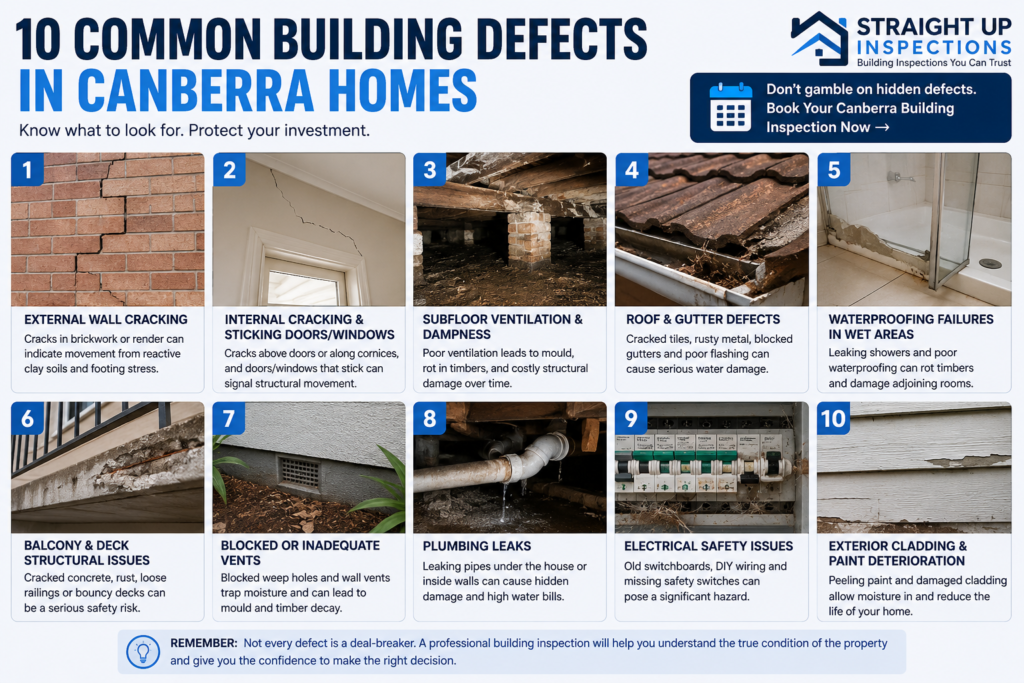
Canberra’s unique landscape—reactive clay soils, frosty winters, and a mix of ageing and modern housing stock—creates a perfect storm for building defects. Over the years, our team at Straight Up Inspections has crawled through thousands of subfloors, climbed into countless roof voids, and walked every room of properties from Gungahlin to Tuggeranong. We’ve seen the same problems crop up time and time again.
Knowing these common defects before you buy isn’t just interesting—it’s financially protective. A crack might be nothing, or it might be the first sign of major structural movement. A little dampness could be a simple ventilation fix, or it could mean a full bathroom waterproofing failure. This guide breaks down the 10 most frequent building defects we uncover in Canberra homes, explains what causes them, how serious they really are, and what you should do if you spot them.
Don’t gamble on hidden defects.
Book Your Canberra Building Inspection Now →
1. External Wall Cracking (Brickwork & Render)
What it looks like: Vertical, horizontal, or stepped cracks in external brick walls or rendered surfaces. Stepped cracking that follows the mortar joints is especially telling.
Why it happens in Canberra: Much of the ACT sits on highly reactive clay soils that expand when wet and shrink during dry spells. This constant ground movement places stress on footings. Older homes with inadequate footings, or newer homes where soil conditions weren’t properly engineered, are most at risk.
Is it serious?
- Hairline cracks (<2mm) are often cosmetic and due to normal thermal movement.
- Cracks 2–5mm with a stepped pattern can indicate moderate footing movement and should be monitored.
- Cracks >5mm, especially if they’re wider at the top than the bottom, or accompanied by internal cracking, are a red flag for significant structural movement. A structural engineer’s assessment is recommended.
2. Internal Cracking and Sticking Doors/Windows
What it looks like: Cracks appearing above door frames, along cornices, or at wall-ceiling junctions. Doors that suddenly jam or won’t latch, and windows that are difficult to open or close.
Why it happens: Like external cracking, internal movement usually traces back to footing settlement or slab heave. It can also be caused by inadequate lintels above window and door openings, roof frame spread, or simply poor plasterboard installation.
Is it serious?
Not all internal cracking means the house is falling down. However, if multiple doors are sticking, cracks are reappearing after patching, or you notice gaps between walls and floors, it strongly points to ongoing movement. Our report will help you distinguish between cosmetic and structural issues.
3. Subfloor Ventilation & Dampness Problems
What it looks like: A musty smell, visible mould on floor joists, rot in timber stumps or bearers, and condensation on subfloor surfaces. You might notice cupped or lifting floorboards inside.
Why it happens: Canberra’s older homes, particularly those built pre-1980s, often have insufficient subfloor ventilation. Vents may be blocked by garden beds, paving, or simply never installed in adequate numbers. Enclosed subfloors trap moisture from the soil, leading to rising damp and timber decay. Leaking pipes under the house make the problem ten times worse.
Is it serious?
Absolutely. Poor ventilation doesn’t just smell bad—it rots structural timbers over time. In severe cases, floor joists and bearers can lose their load-bearing capacity. Fixing ventilation is usually straightforward; repairing rotted framing is not.
4. Roof and Gutter Defects
What it looks like: Cracked or slipped roof tiles, rusty metal roofing sheets, sagging gutters, missing or deteriorated flashing around chimneys and parapets, and water stains on internal ceilings.
Why it happens: Canberra endures everything from summer storms to winter frost. Tile roofs can become brittle; metal roofs corrode at fixings. Box gutters on older homes (common in inner-north character houses) are notorious for blocking and overflowing into the roof void. Poor maintenance compounds the issue.
Is it serious?
A leaky roof will only get worse. Water entering the roof void soaks insulation, rots framing, and creates conditions ripe for mould. Replacing a few cracked tiles is minor; a full roof restoration or gutter replacement is a significant cost. We’ll tell you which one you’re facing.
5. Waterproofing Failures in Wet Areas
What it looks like: Water-damaged skirting boards adjacent to showers, tiles that sound hollow when tapped, cracked or missing grout, damp smells in bathrooms and laundries, and bubbling paint or plasterboard in adjoining rooms.
Why it happens: Waterproofing standards have improved dramatically, but many Canberra homes built before the 2000s have inadequate or completely failed shower waterproofing. Even in newer builds, poor workmanship, the wrong waterproofing membrane, or missing puddle flanges lead to leaks within the first few years.
Is it serious?
A failed shower waterproofing system is a major defect. Water leaking through the floor can rot subfloor timbers, damage adjoining rooms, and promote mould growth. Repairs often require stripping the bathroom entirely—a multi-thousand-dollar job.
6. Balcony and Deck Structural Issues
What it looks like: Cracking or spalling concrete on balcony edges (exposed reinforcing steel), springy or bouncy timber decks, loose handrails, and visible rust stains.
Why it happens: In Canberra, concrete balconies are prone to “concrete cancer”—where water penetrates the concrete and rusts the internal steel reinforcement, causing expansion and cracking. Timber decks suffer from inadequate weather protection, poor original construction, or decay around fixings. Balustrade non-compliance (height, gaps) is also common.
Is it serious?
A failing balcony is a safety hazard first and a structural liability second. We treat balcony defects with high urgency. If a balustrade isn’t secure or the structure feels unstable, it needs immediate rectification. Concrete cancer repairs can be extensive.
7. Concrete Cancer (Spalling Concrete)
What it looks like: Chunks of concrete breaking away from walls, columns, or balcony edges, with rusty steel reinforcement visible underneath. Often accompanied by rust stains.
Why it happens: Carbonation of the concrete over time reduces its alkalinity, allowing the steel reinforcing inside to rust. The rust expands, cracking the concrete from within. Canberra’s freeze-thaw cycles can accelerate this in exposed locations.
Is it serious?
Yes. Spalling is progressive and only worsens. It reduces the structural capacity of the affected element and is often expensive to repair properly. We flag it as a major defect whenever found.
8. Electrical Safety Hazards
What it looks like: Old fuse boxes with ceramic rewireable fuses, missing safety switches (RCDs), exposed wiring, DIY electrical work, double adaptors overloaded in the switchboard, and deteriorated cabling (especially VIR rubber cabling in pre-1960s homes).
Why it happens: Many older Canberra homes haven’t had their electrical systems updated in decades. Even some renovated homes have only had cosmetic electrical work done without upgrading the main switchboard or adding RCD protection.
Is it serious?
Electrical hazards are life-safety issues. While we don’t dismantle electrical components, we visually inspect what’s accessible and note obvious defects. A home without RCD protection on power and lighting circuits doesn’t meet modern safety standards and should be rectified urgently.
9. Poor Site Drainage
What it looks like: Water pooling near the house after rain, soil eroded away from footings, garden beds built up above the damp-proof course, and downpipes discharging directly beside walls.
Why it happens: Canberra blocks can be flat or steeply sloped. Inadequate surface drainage, blocked stormwater pipes, or landscaping alterations often channel water toward the building rather than away from it.
Is it serious?
Over time, poor drainage saturates the soil around footings, increasing movement in reactive clay soils and promoting rising damp in walls. It’s a classic example of a seemingly minor defect (blocked drain) causing a major structural consequence (footing movement). Fixing drainage is often straightforward once identified.
10. Unapproved or Defective Renovations
What it looks like: A garage that’s been converted into a living space, a pergola enclosed as a sunroom, or a wall removed to “open up” the kitchen—all without council approval or proper structural engineering.
Why it happens: Homeowners trying to add value or space on a budget often skip the formal approval process. In Canberra, even some deck additions and carport enclosures require building approval, and non-compliance is more common than you’d think.
Is it serious?
Unapproved works can affect your insurance, future saleability, and, most importantly, structural safety. A load-bearing wall removed without proper beam installation can cause sagging ceilings and roof movement. We note any work that appears unapproved and recommend you verify compliance with ACT Planning and Land Authority.
What to Do If Your Property Has One (or More) of These Defects
If you’re reading this before buying, the most powerful thing you can do is get a professional building inspection. A detailed report will tell you:
- Which defects are major vs. minor
- The likely cause and severity
- Whether you need a specialist (engineer, plumber, electrician) to quote for repairs
- Realistic cost estimates to help with price negotiation
A defect is not necessarily a deal-breaker. It’s information. Information you can use to renegotiate the purchase price, ask the vendor to repair before settlement, or budget for future maintenance.
If you’re already in the process of buying, check our guide: What Happens During a Building Inspection in Canberra so you know exactly what to expect on inspection day.
Get clarity on your property’s true condition.
Book a Canberra Building Inspection Online →
Why Choose Straight Up Inspections?
- Canberra local knowledge – We know the suburbs, the soil, and the building styles that produce these defects.
- Specialist building inspectors – We focus entirely on structure and safety. We don’t do pest inspections, but we’ll flag any visible timber pest damage or conducive conditions so you can seek specialist pest advice.
- Open 7 days, 9am–5pm – We work around your schedule.
- Detailed, photo-rich reports – Delivered within 24 hours, with plain-English explanations—no confusing jargon.
- Fully licensed and insured – Professional indemnity and public liability insurance for your peace of mind.
📞 Call 0423 476 649
📧 Email office@straightupinspections.com.au
🌐 Canberra, ACT · Open 7 days · 9am–5pm
Request a Quote Now →