Picture yourself at the entrance of your brand-new Canberra home, all set to pick up the keys and settle the last payment. The walls are freshly painted, the stone countertops gleam, and the house looks perfect from the outside.
But what’s hidden behind those clean walls and under that new concrete floor might be serious issues like building code breaches, structural problems, or faulty installations that could cost you tens of thousands of dollars.
In the Australian Capital Territory (ACT), skipping an independent new build handover inspection is a big financial risk.
Many homebuyers think a private building certifier or local council inspector checks everything for quality. They’re wrong.
This guide explains the structural, financial, and legal dangers of skipping your practical completion inspection in Canberra, Googong, and Queanbeyan.
Building Consultants is the trusted expert you need before you release your final payment.

1. The Reality of the ACT Construction Boom
The rapid expansion of newer ACT estates—such as Denman Prospect, Taylor, Whitlam, Macnamara, and nearby Googong—has placed immense pressure on the construction sector. To meet tight deadlines, builders rely heavily on cascading networks of sub-contractors, which inevitably creates gaps in quality control.
Certifier Compliance vs. Independent Quality
It is vital to understand the difference between what a building certifier does and what an independent inspector checks:
The Building Certifier: Appointed to ensure the building meets the bare minimum regulatory milestones required by law. They verify compliance with the National Construction Code (NCC) and local planning laws. They do not check cosmetic finishes, workmanship quality, or operational functionality.
The Independent Handover Inspector: Works exclusively for you, the buyer. Our role is to scrutinize every square inch of the property against Australian Standard AS 4349.1 (Residential building inspections), AS 4349.3 (Timber pest inspections), and the Guide to Standards and Tolerances.
Skipping an independent inspection means gambling your life savings on the hope that every single trade cut zero corners.
2. The Financial Reality of Post-Handover Defects
Once you sign off on practical completion and release the final payment, your legal leverage drops to near zero. While statutory warranties exist under the Building Act 2004, getting a builder to return to a site once they have received 100% of their money is notoriously difficult.
The Power of Financial Leverage
Before handover, your final milestone payment (typically 5% to 10% of the total contract value) serves as your ultimate bargaining chip.
Legal and Financial Reality: If defects are identified during a professional handover inspection, you have the contractual right to demand rectification before settling the final bill. The builder is highly motivated to fix these issues quickly because their cash flow depends on your sign-off.
Once paid, your project moves to their maintenance and warranty ledger. Responses slow down, trades are reallocated to active sites, and you may face a protracted battle in the ACT Civil and Administrative Tribunal (ACAT).
3. High-Cost Structural Defects: Slab Heave
Among all building defects, foundation failure is the most expensive to repair. In the Canberra region, slab heave is a severe structural issue that costs homeowners hundreds of thousands of dollars in forensic engineering and underpinning works.
Understanding Slab Heave Mechanics
Slab heave refers to the upward movement of a concrete floor slab caused by the uneven swelling of highly reactive clay soils. Large portions of the ACT feature soil profiles classified as Class H1, H2, or E (Highly to Extremely Reactive) under AS 2870 (Residential Slabs and Footings). When these clay soils absorb moisture unevenly, they expand with immense hydraulic force, tilting or fracturing the foundation.
Why It Occurs in New Builds
Slab heave is almost always triggered by poor site management and non-compliant workmanship during construction, including:
Deficient Site Drainage: Failing to slope the ground surface away from the slab perimeter, causing water to pool next to the footings.
Damaged Stormwater Systems: Downpipes left unconnected or underground stormwater lines cracked or blocked by construction debris.
Improper Cut-and-Fill Management: Failing to install adequate retaining structures or clay aprons to seal the footing zone.
Symptoms—such as sticking doors, cracking plasterboard, and buckling external brickwork—often take 6 to 24 months to manifest. If you do not document non-compliant drainage at handover, proving the builder’s liability becomes incredibly difficult. Rectification costs can easily range from $30,000 to over $150,000.
4. The Threat of Waterproofing Failures
If foundation problems are the most costly, then waterproofing failures are the most frequent and damaging type of internal issue.
Wet areas like bathrooms, ensuite bathrooms, and balconies depend on a continuous chemical membrane that is installed following the AS 3740 standard for waterproofing domestic wet areas.
The Slow Burn of Water Damage
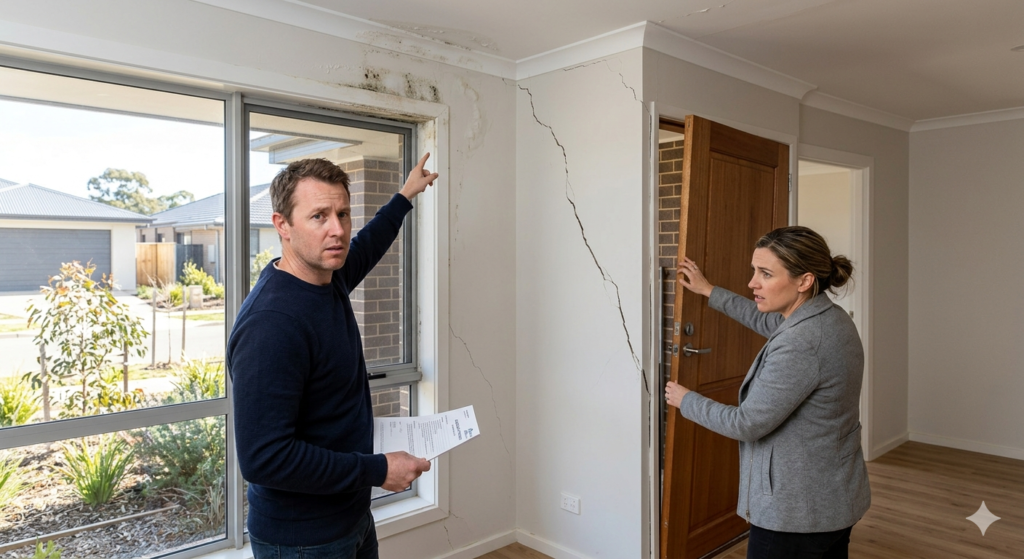
A waterproofing leak is usually not noticeable during a regular inspection.
Water slowly moves behind tiles, travels along floor supports, and can cause structural wall framing to rot over several months.
How StraightUp Inspections Detects Wet Area Failures
At StraightUp Inspections, we use advanced tools to check for moisture issues.
Electronic Moisture Meters: We measure moisture levels inside the walls near showers to find hidden leaks.
Thermal Imaging Technology: Using infrared cameras, we can see temperature differences behind walls and floors.
This helps us spot water leaks and missing insulation without having to damage the property.
If a shower membrane fails during handover, the builder has to fix it, which saves you money.
On average, fixing issues after handover can cost between $15,000 and $30,000.
5.What We Inspect: A Systematic Check
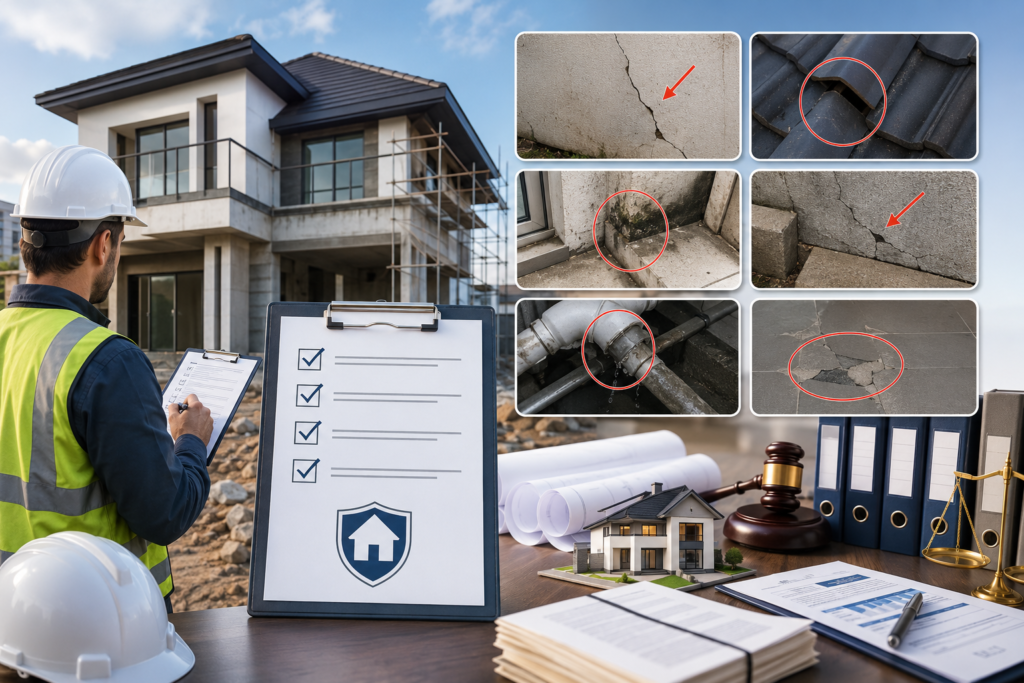
Our standard inspection at StraightUp Inspections covers five areas of your new home to ensure it is safe, compliant, and built to quality.
The Roof Cavity & Structure: We crawl into the roof space to check the trusses and support structures (following AS 1684 standards), look for gaps or fire risks in insulation, and confirm that roof coverings are continuous and not torn.
External Finishes & Brickwork: We check how bricks are aligned, look for expansion gaps, weep holes, and damp-proof courses (DPC), and ensure gutters slope properly to avoid rust and pooling.
Internal Finishes & Joinery: Using bright lights, we inspect walls and ceilings for plaster issues, test doors and windows to make sure they open and close smoothly, and check that joinery is aligned and stone countertops are properly installed.
Concrete Subfloor & Drainage: We verify that the ground slopes away from the slab by at least 50mm in the first meter, and we check that there is enough airflow under the floor.
Timber Pest Risk Evaluation: We conduct a baseline check under AS 4349.3 to make sure termite barriers are intact and that no construction waste is placed against the house.
6.The Legal Landscape in the ACT
Handling building disputes needs clear, documented evidence.
The ACT Building Act 2004
Under the Building Act 2004, residential construction comes with mandatory warranties.
Structural issues, like faulty framing or foundation problems, are covered for 6 years after the project is finished. Non-structural issues, such as poor paint jobs or small cracks, are only covered for 2 years.
The Burden of Proof
If a problem is found after handover and the builder doesn’t take responsibility, you have to prove the issue.
If you go to the ACT Civil and Administrative Tribunal (ACAT) without a detailed report from an expert, your case might not hold. A full report from StraightUp Inspections gives you a clear, legal record of the home’s condition at the end of the build.
7.Why Choose StraightUp Inspections & Building Consultants?
Protecting your biggest financial investment needs local experts with strong technical knowledge.
We are the top independent option in Canberra, Googong, and Queanbeyan.
Extensive Technical Expertise: We are experienced in building inspection, with deep knowledge of structural integrity and termite tracking..
Knowledge of Local Conditions: We understand how Canberra’s environment, like clay soils and cold winters, can affect new builds and where problems might hide.
Solicitor-Ready Documentation: Our reports are written in simple language, include high-quality photos, and reference Australian Standards clearly.
They are structured to meet the high standards needed by insurers, solicitors, and ACAT.
True Independent Advocacy: We have no ties to builders, developers, or real estate companies.
Our only goal is to protect your investment by providing honest, clear information.
8. Real-World Costs of Skipping an Inspection
Case Study 1: Failed Ensuite Waterproofing
The Issue: A buyer missed the handover inspection for a new home in Taylor.
The tiler had rushed the work on the shower membrane, creating a tiny tear near the waste pipe.
The Fallout: Four months later, water damage caused the floor joists to rot and leaked into the ceiling of the living room below.
The builder disagreed with the cause, so the owner had to pay out of pocket for a full bathroom removal and structural repairs.
Total Out-of-Pocket Cost: $22,500
Case Study 2: Crushed Stormwater & Slab Heave
The Issue: An owner in Googong trusted the site supervisor and skipped an independent inspection.
Excavators had accidentally crushed an underground stormwater pipe and sloped the backyard toward the house.
The Fallout: Heavy rain caused water to collect near the foundation.
Within 14 months, the reactive clay expanded, causing a serious slab heave that cracked internal walls and jammed doors.
Total Out-of-Pocket Cost: $64,000
9.The StraightUp Handover Process
Our step-by-step process ensures you’re not rushed into signing off too quickly by a pushy builder:
Notice of Practical Completion: The builder claims the home is ready for the final walkthrough and sends the final invoice.
Book Our Team: Contact StraightUp Inspections immediately so we can arrange a site visit during normal working hours.
The On-Site Audit: Our inspector thoroughly checks the property using laser levels, moisture meters, and thermal cameras.
Review the Report: Within 24 to 48 hours, we provide a detailed, photo-based digital report compared to Australian Standards.
Issue to the Builder: You show the report to the builder before making the final payment and give them clear instructions for any necessary fixes.
Final Verification: Once the builder claims the repairs are done, we can do a final check to make sure everything is fixed before you make the last payment.
Conclusion: Protect Your Investment
Building a new home is a big financial step.
Don’t face problems at the very end. Skipping an independent handover inspection to save a few hundred dollars is a huge financial risk that could leave you dealing with structural, plumbing, and drainage issues.
By choosing StraightUp Inspections & Building Consultants, you get total confidence.
Make sure your property is safe, follows the law, and is structurally sound. Contact our expert team today to book your handover inspection in Canberra, Googong, or Queanbeyan, and get the peace of mind you deserve.

How Access Canberra Regulations Affect Your Commercial Fit-Out
Planning a commercial fit-out in the Australian Capital Territory (ACT)...
Read More
As-Built Surveys Canberra | Verifying Unapproved Structures
The Australian Capital Territory (ACT) property market operates within one...
Read More
Commercial Building Inspections | Comprehensive Asset Audits
Acquiring, managing, or leasing commercial real estate in the Australian...
Read More